The start of my journey to develop machine learning skills as a mechanical engineer.
Lets start with something fun, like classifying Skyrim weapon sets.
import numpy as npimport pandas as pdimport matplotlib.pyplot as pltfrom sklearn.metrics import r2_scorefrom sklearn.datasets import load_irisfrom sklearn.model_selection import train_test_splitfrom sklearn.neighbors import KNeighborsClassifierfrom sklearn.metrics import accuracy_score, classification_report, confusion_matrix, ConfusionMatrixDisplay
df = pd.read_csv(r"C:\Users\harri\OneDrive\Documents\Python Projects\Skyrim_Weapons_Dataset\Skyrim_Weapons.csv")print(df.head())
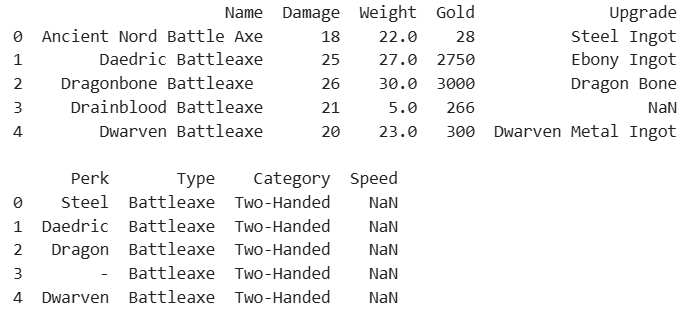
Looking at the data I imported, there are a variety of features like Damage, Weight, Gold, Upgrade Material, Perk, Type, Category, and Speed.
If I try to train a model with all of them, it might confuse the accuracy. For example, the Gold (price of the weapon) probably is a poor indicator of what type of weapon it actually is. Therefore, it is best to determine what is relevant.
If I want to build a model that correctly predicts the label of category, then I should pick the best features to train on, such as damage and weight.
X = df[['Damage', 'Weight']]y = df['Category']
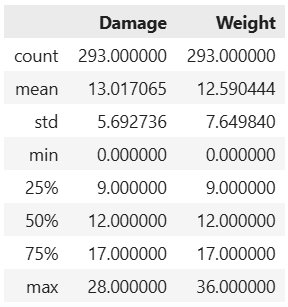
X.describe()
X_train, X_test, y_train, y_test = train_test_split( X, y, test_size = 0.2, random_state = 42)
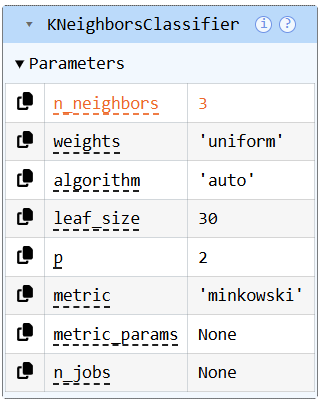
model = KNeighborsClassifier(n_neighbors = 3, weights = 'uniform')
model.fit(X_train, y_train)
predictions = model.predict(X_test)
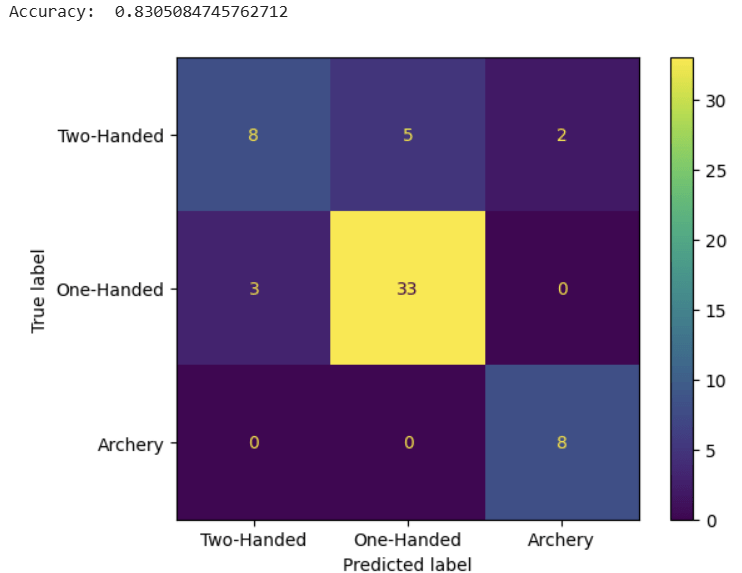
accuracy = accuracy_score(y_test, predictions)print('Accuracy: ', accuracy)print('\nPredictions:')print(predictions)print('\nActual Label:')print(y_test)

cm = confusion_matrix(y_test, predictions)
disp = ConfusionMatrixDisplay( confusion_matrix = cm, display_labels = y.unique())disp.plot()print('Accuracy: ', accuracy)plt.show()
 Portfolio of Harrison Tracy